
Since most of my projects document direct ancestors of a selected descendant, I regularly use the ahnentafel (meaning “ancestor table”) numbering system on my reports and charts. Under ahnentafel, an ascending numbering system, the selected descendant is assigned the number [1] (ahnentafel numbers are enclosed in square brackets); the father’s number is 2x the child’s, so[2]; and the mother’s number is the father’s +1, or [3].
The same simple calculations are then applied to assign numbers to the father’s parents: His father’s number would be [4] (which is 2x [2]) and the mother’s is [5] (which is [4] + 1). The mother’s parents’ numbers would be [6] and [7] using the same calculations.
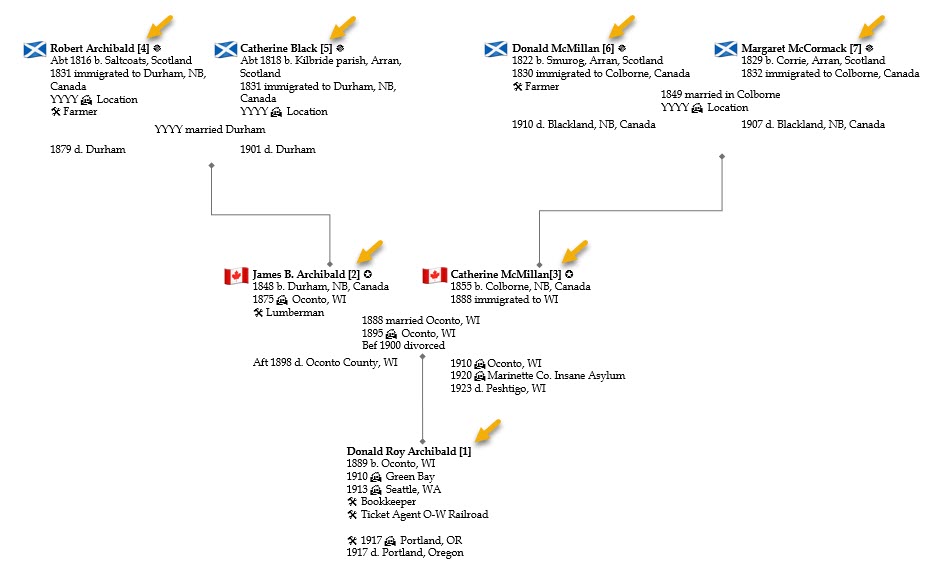
This numbering system makes it easy to quickly distinguish between many people with the same last name (or the same first and last name!) and to identify parents of children (and vice versa) without having to remember their relationships by name.
Within each nuclear family, the children are numbered in birth order using lower-case Roman numerals. This child numbering system is carried over from the Register system and the similar NGSQ system, which are both descending numbering systems, meaning they start with the earliest known ancestor and “work their way down”, rather than up, like ahnentafel. An example of the basic child numbering approach used in all three systems.


 Michael L. Butler
Leave a comment